
Weight Regain After Ozempic: What Happens Next?
Weight regain after Ozempic is one of the most common concerns people have once they reach their target weight or start thinking about stopping the medication. The thousands of daily search queries on Google confirm this. Whilst this page focuses on Ozempic, weight creep issues after use are common with all GLP-1s.
During treatment, appetite is curbed, portions become easier to manage and the constant pull towards food often fades into the background. For many, it’s the first time in years that eating feels under control. But sadly, that control isn’t permanent: Ozempic only helps regulate appetite while you’re actually taking it. What happens after you stop is a different phase entirely, and one that many people feel unprepared for.
What Happens When Stopping Ozempic?
When you stop Ozempic, the medication doesn’t leave your system immediately; it can linger for a few weeks. During that period, appetite may still feel manageable, which many users report creates a false sense that everything is holding steady. Users report a similar experience when coming off Mounjaro.
Then slowly, things begin to shift. As the medication clears, hunger signals return, food becomes more appealing again, food noise is back and the effort required to manage eating increases. What once felt easy and automatic now requires a lot of attention.
This change can feel gradual for some, but quite sudden for others. Either way, it marks the point where control needs to come from a wide range of other factors, rather than simply coming from the medication. You’ve put in the time, often 12 months or more, and for many people, incurred a significant financial investment as well. You’ve seen the results, heard the compliments, and experienced what it feels like to be back in control. No one wants to lose that. That’s why this next phase matters. It’s not about going backwards; it’s about holding on to what you’ve already achieved.
Weight Regain After Ozempic
Weight regain after Ozempic is common, not because the medication fails, but because the behaviours underneath it often remain unchanged. While on Ozempic, appetite is reduced and food-related thoughts are quieter, which makes eating feel much easier to manage.
But the harsh truth is that all the habits, eating patterns, emotional triggers and automatic responses to food that led to weight gain in the first place don’t simply disappear. They are all still there under the surface; they’re just not being tested in the same way. The time spent on the medication is the ideal opportunity to build something new to replace the former habits, behaviours and eating patterns.

Support Not Keeping Pace
In clinical guidance, GLP-1 treatments are intended to be supported by behavioural and lifestyle input alongside the medication. In practice, however, that level of structured support is often limited or, in many cases, almost non-existent. As a result, many people are left to navigate the transition off the medication with very little guidance. While the medication is highly effective, the support around what happens next is often not keeping pace. That was one of the key reasons behind the research and writing of our book, The GLP-1 Legacy.
Gaining Weight After Ozempic
Without a deliberate shift in eating patterns, mindset and daily routines during that post GLP-1 period, maintaining weight loss becomes difficult once appetite returns. When it does, those old patterns can re-emerge quickly and catch people unawares. Avoiding weight regain involves creating structure around eating, planning, recognising emotional and environmental triggers, and building habits while on the medication that continue after it is stopped. Read about weight regain after Wegovy in another of our posts.
Ozempic Was Never Meant to Replace Behaviour
It’s important to understand what Ozempic actually does. It manages appetite while you are taking it. It does not permanently change the underlying drivers of eating behaviour; they just sit there in the background. A useful way to think about it is this: blood pressure tablets lower blood pressure while you take them, but if you stop, blood pressure rises again, unless something else has changed. The same principle applies here. If new habits, routines, and ways of thinking about food haven’t been established during treatment, the body will almost seamlessly revert to previous patterns. And it often does so quickly.
Building Habits While Appetite Is Reduced
The period on Ozempic is not just about losing weight. It’s a window where change is both possible and easier. With reduced hunger and fewer intrusive food thoughts, the effort required to make better decisions is lower, making it an ideal time to establish consistent habits.
This includes eating at regular times rather than reacting to hunger, recognising the difference between physical and emotional triggers, slowing down when eating, understanding the effects of proteins, carbohydrates and fats, and becoming more aware of portion sizes.

The phase while on the medication creates space to notice thinking patterns that often drive overeating. All-or-nothing thinking, using food as a reward, or eating in response to stress or boredom become easier to spot when food noise is muted and appetite is under control. These patterns don’t change on their own, but during this phase, they are easier to interrupt.
Why Willpower isn’t Enough
When appetite returns, many people try to rely on willpower to maintain their weight, but this rarely works for long. Willpower fluctuates; it’s affected by stress, fatigue, environment and how strong hunger signals are at any given time. When appetite increases, relying on willpower alone becomes difficult to sustain.

What works better is structure. Simple, repeatable behaviours reduce the need to make constant decisions; eating patterns become more predictable and less dependent on how you feel in the moment.
One practical strategy is to introduce a pause before eating. When the urge appears, wait a few minutes and ask yourself whether this is really physical hunger or is it something else: Am I bored, stressed, tired, or depressed? There are many thoughts that often sit behind the impulse. So press the pause button, just like you are watching a movie, take a few seconds to really think it through. That short pause creates space for you to make a different and better choice.
How to Maintain Weight Loss After Ozempic
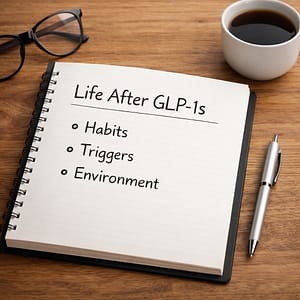
Maintaining weight loss after Ozempic is not about being stricter; it’s about having a structure that holds up when motivation drops and appetite returns. This is where many people struggle, relying on willpower rather than something more consistent.
What works better is a simple, repeatable way of eating instead of reacting in the moment, recognising triggers early before they become automatic, planning to reduce impulsive decisions, and accepting that hunger will return and learning how to respond to it rather than fight it.
The shift is subtle but important. Instead of asking, “How do I try harder?”, the question becomes, “How do I make this easier to repeat?” Because long-term weight maintenance is not driven by effort, it’s driven by behaviours that hold in place even when effort drops. Small, repeatable actions, carried out consistently over time, are what protect against weight regain after Ozempic.
Life After Ozempic is a Different Phase
Most people understandably start their Ozempic journey focused on losing weight, but very few are prepared for what happens after. Weight loss and weight maintenance require different skills. While on the medication, appetite is supported externally and the pressure of constant hunger is reduced. Social situations often feel easier to manage as well; saying no, eating less or navigating restaurants and events requires less effort when appetite is suppressed.
After stopping the medication, however, everything starts to change. The external support is gone, hunger returns, food becomes more rewarding again and the responsibility for managing intake shifts back to you. And social pressures that once felt manageable can quickly start to feel overwhelming again.

Gaining Weight After Ozempic Happens
This is the point where many people feel exposed. What felt manageable before now requires more awareness, more structure and more effort, but it’s also where long-term success is decided. Because this phase is not about relying on the medication, it should be about what you’ve built in its place during that window of opportunity it created.
A Practical Approach to Avoiding Weight Regain
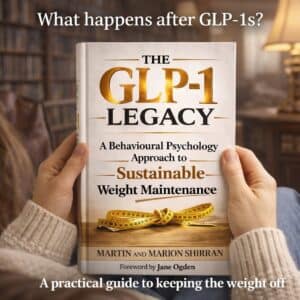
This is exactly where The GLP-1 Legacy fits in. Written by Martin and Marion Shirran, practitioners with decades of clinical experience in behavioural weight management and cognitive behavioural approaches, the book provides a practical framework, a set of proven skills for maintaining weight loss, managing returning hunger, and avoiding the patterns that lead to regain. You can read a sample of the book on our website.
It includes a foreword by Professor Jane Ogden of the University of Surrey, a leading expert in health psychology, highlighting the role of behaviour in long-term weight management.
The book is available on Amazon in Kindle, paperback and hardback formats.
FAQs: After Stopping Ozempic
Martin and Marion’s groundbreaking work has been featured in prominent newspapers such as the Daily Mail, The Times, The Telegraph and the Daily Express. Leading magazines like Vogue, Marie Claire, Good Housekeeping and Reader’s Digest have also recognised their contributions. The Shirrans and several of their clients have also appeared on television on both sides of the Atlantic.
Over a thousand individuals, including medical professionals, celebrities and the general public, have travelled from around the world to experience their weight-loss treatment. Some sought to enhance their appearance, while others prioritised their health, successfully reversing medical conditions like insulin resistance, diabetes, high blood pressure and fatty liver disease.

google-site-verification: googlef6c425f95ce1433a.htm