
The GLP-1 Legacy
FOR CLINICIANS

A Practical Resource Patients Can Use Independently
GLP-1 patient support for clinicians. We wrote The GLP-1 Legacy to address a gap that naturally occurs within current GLP-1 treatment pathways. Patients are typically well supported during the prescription phase, as the focus of clinical care is, quite rightly, on safe and effective weight loss.
However, peer-reviewed studies consistently demonstrate that weight regain is common after GLP-1 medications are discontinued, with a substantial proportion of lost weight returning within the first year. This reflects what is well understood within clinical practice. GLP-1 medications regulate appetite during use, but do not replace the need for sustained behavioural change. As the medication is reduced or stopped, appetite returns, food becomes more rewarding again and small behavioural shifts begin to appear.
Without established changes to support this transition, these shifts tend to build into gradual weight regain. It is during this transition period that many individuals need the most support, whether clinical or behavioural. Yet this phase often sits outside the scope of routine consultations, leaving people to navigate it alone or rely on fragmented and inconsistent sources of information. It was this recurring pattern, observed through both clinical work and wider public behaviour, that led to the research and writing of the book.
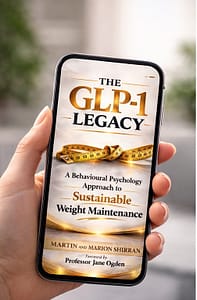
While the book was written as a patient resource, direct recommendations by doctors were not part of the original focus. It has therefore been encouraging, maybe not surprising, to see doctors begin to use it as a resource they can recommend to patients to support them as they approach the transition phase of treatment.
Rather than adding to consultation time, it gives patients something structured to work through independently, helping them understand what to expect as treatment is reduced or stopped, and how to manage the return of appetite and behavioural patterns. This allows key messages to be reinforced outside the consultation, supporting more consistent self-management during a period that is often less structured. The book focuses on:
- Understanding the changes that occur as medication is reduced or stopped
- Managing appetite, cravings and behavioural triggers
- Building sustainable routines that support long-term weight maintenance
- Navigating real-world challenges such as social eating and alcohol
Reducing Time Pressure in Consultations
By directing patients to a clear, structured resource, clinicians have more time to focus on patients’ personal concerns, application and problem-solving. The book acts as a foundation for common behavioural and post-treatment challenges, such as post-GLP-1 weight regain.
Where This Fits in Practice
The book is not intended to replace clinical guidance, but to hopefully sit alongside it as a practical extension of the consultation. It can be introduced at the point of initiation, during dose adjustment, or as patients begin to consider reducing or stopping medication. It is particularly relevant when patients start to experience changes in appetite, confidence or eating patterns. Used in this way, it provides a consistent framework that patients can return to between appointments, helping to reinforce key behavioural messages without adding to consultation time.
Clinicians using the book as a supporting resource report that its value lies in two key areas: supporting conversations around the importance of behavioural change while patients are on the medication, and providing a clear structure for discussions as they transition off.

Clinical Perspective
The book features an introduction by Professor Jane Ogden, Professor of Health Psychology at the University of Surrey, reflecting the importance of behaviour in long-term weight management. She is one of the UK’s leading voices in the field, having authored several influential books and published over 200 academic papers, primarily in peer-reviewed journals, with a particular focus on behaviour, eating and weight management.
The GLP-1 Legacy has also been positively reviewed by Dr Sarah Clarke, who described it as providing ‘the guidance that is often missing when GLP-1 treatment ends’.
The book was written by Martin and Marion Shirran, practitioners specialising in behavioural weight management and health psychology, with over 15,000 hours of clinical experience and insights drawn from interviews with over 100 GLP-1 users. Their past work around the development of an upgrade to CBT into Tactile Cognitive Behaviour Therapy was endorsed by Professor Dryden of Goldsmiths University, London and Professor Zimbardo of Stanford University, San Francisco.
Accessible for Patients
Patients can access the book easily via a simple online route. The book is available as a download or in printed format. For Amazon Kindle subscribers, it may be available free of charge through their membership, allowing immediate access without added barriers. Patients can begin reading immediately and refer back to the material as their treatment progresses.

FAQ’s
Marion Shirran, as a director of Oxford Therapeutics Limited, is proud to be a registered Stakeholder in NICE – the National Institute for Health and Care Excellence. Additionally, she is involved in the government’s All-Party Parliamentary Group on Obesity.